Imagination Set Free by Cory Eichman
I sometimes think of Imaginations like horses, especially when distinguishing between an imagination running wild and an Imagination set free.
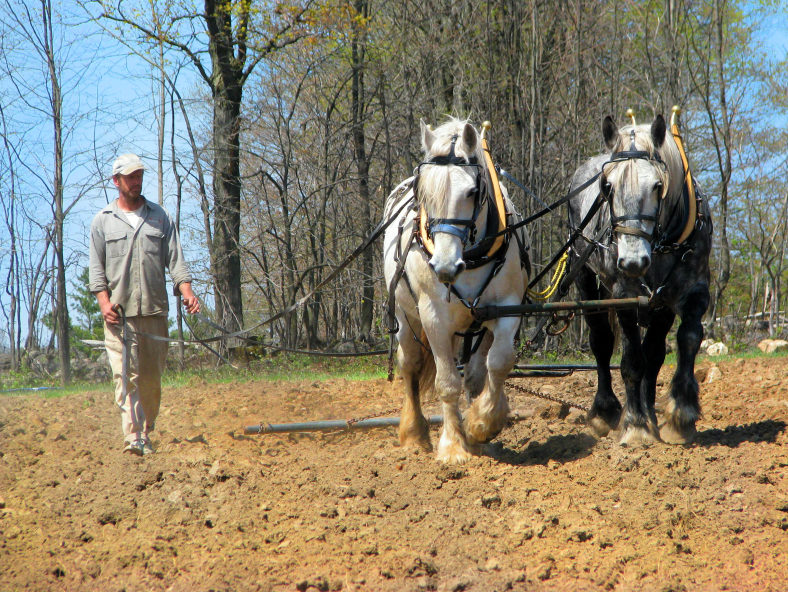
I don’t consider myself a horse whisperer. I came to work with draft horses late in my farming career. You might say it was a mid-life crisis, trying something that I’d always wanted to do, but hadn’t. I learned while I was already managing my farm. Not something I would recommend, but it was my only option. I worked with horses as my main power source for the csa market garden work for ten years, but only ten years. There are many people who have done it their whole lives and are way more knowledgeable than me. I do, however, have a fair amount of experience working with Imaginations, and I see similarities.
Lynn Miller, whose many books on working with draft horses were invaluable to me, talks about three approaches to training, but also working with, horses. First is what he called “Acceptance training.” When working with horses we want them to accept our leadership. We ask them to do work to fulfill our needs, sometimes involving very precise actions. We need them to accept that direction. As herd animals, they do look for the Alpha female to follow. We have to become that Alpha.
The second approach is “Submission training.” This is what is often called “breaking” a horse, where we overpower the horse's will with our own. There are many practices, some cruel, some not, that are designed for this.
The third tactic is called, “get ‘er done.” Most horses like to work and like engagement and feel the accomplishment of a task. The saying “Miles Makes Manners” expresses that the more you work with a horse the easier it is to work with them, but it has to be the right kind of work.
I came to realize, for me, it had to be a combination of all of these approaches. What I learned was to be flexible so that I could read when best to lean towards one way or the other: Encouraging them to accept my leadership, making them submit to my will, or simply getting the work done. Different horses needed different approaches at different times.
Horses and Imaginations
Everything I just said about horses can apply to Imaginations. I’m referring to Imagination, in this case, as a source of knowledge.
Imaginations arise out of our astral nature. Our astrality is filled with feelings of liking and disliking, of sensations, and inner experiences. Since we are also gifted with an ego/spirit that permeates our astral, we could say Imaginations arise in our Soul. The most basic type of Imagination is the perception of an aura. An aura is a color or shape or movement we can “see” around something that expresses its inner quality. It’s not something we see with our eyes, but perceive with our Soul. Imaginations can also take the form of symbols, pictures, or even stories. The power of these images is that they can hold multiple layers of meaning. A single picture can speak to us our entire lives, meeting us and inspiring us at whatever stage of life we are.
My horses have broken out of their pasture fence a few times, or found I’d left a gate ajar. What begins as excitement, when they first start running wild, quickly turns to panic. They are drawn to an opening, but get scared when there’s no boundary. Sometimes when I lead them out into a new pasture space they will run the perimeter of the fence to see where the border is before settling in to graze contentedly. They live in that dynamic tension between wanting freedom and wanting a boundary.
Imaginations live in the dynamic tension between the personal-subjective and expressing an impersonal aspect of reality. The nature and energy of the horse lies in the dynamic between boundary and freedom. It’s a dynamic we don’t want to snuff out. Likewise, the power and energy of an Imagination lies between the personal and universal, a dynamic we also don’t want to snuff out.
Clarity of thought and self knowledge act as boundaries for Imaginations, helping us distinguish what in a picture comes out of our own likes and dislikes, our own perspective, and what is not our own, what lives in the Imagination as a source of knowledge about the world.
My first inclination with horses was to primarily work with acceptance. In my idealized, inexperienced world, I thought I would just direct the horses to do something and they would do it. But some horses will question that approach and test the boundaries. Some horses will quickly try to take advantage of you if they don’t find a boundary and start running a bit wild.
I had a Belgian heavy horse named Bert. She was a bit nervous, but had loads of experience from her upbringing on an Amish farm, and was a very disciplined workhorse. She mostly behaved herself when teamed up with my lead mare, Molly. But Bert recognized my inexperience and began questioning my ability to lead the team. I had a near disastrous runaway wagon experience that tested all of us.
I knew the warning about inexperienced teamsters ruining good horses. I knew of round-pen work but had no experience with it, and thought I should try. I took her into a small paddock, just she and I, with a buggy whip. She definitely knew buggy whips from her past and was suspicious whenever she saw it. The idea of the round-pen is to get a horse to focus on you, position your body language and try to control her with verbal commands. If she balked and wouldn’t move, I’d crack the whip (just make the sound not hit her with it). Trying to read her body language and her reaction to mine, at one point I put down the whip and stepped away from it. She walked over, picked up the whip in her mouth and shook it at me. I burst out laughing. We had made a breakthrough and I gained a great deal of respect for her intelligence and spunk. I realized she was primarily a “get ‘er done horse” and, the more I worked with her, the more she became my most solid and reliable partner. I had to make her do what I wanted but in a way that worked with her nature.
Imaginations are gifts, given to us by Spiritual Beings. Imaginative pictures come to us through our astral nature. They can be fleeting images or stories connecting ideas. If we shrug them off, or dismiss them as just “imagination,” we are making them submit to our materialistic expectations of reality. This can kill the spirit of the Imagination. However, if we blindly accept whatever experience comes up within us, we can allow our personal perspective and wishes to run wild. The Imagination then says more about us than about the world. Similarly, horses can sometimes reflect our soul state. There’s a saying, if you go into a job with horses thinking it will only take an hour, it will take all day, but if you expect it to take all day, it will only take an hour. If we feel rushed, or anxious, or uncertain, many horses will pick up on that and reflect the uncertainty, making it harder to get the work done.
The “get ‘er done” mode for Imaginations, for me, is engaging in artistic activities: drawing, painting, music, movement, creative writing. The arts allow the Imagination to move outside the confines of physical thinking. It’s a practice to help set the Imagination free. But you have to do it! You have to set pen to paper, fingers to keyboard, brush to canvas, hands on the clay. Sometimes the very act of doing the art is an invitation for the imagination.
Imaginations, like horses, ask us to pay attention, have courage, and have the right mix of doubt and trust. If we are overly self-confident, we can miss the unexpected. Imaginations, like horses, can become our partners in navigating the world, opening up new ways of finding meaning.
Cory Eichman co-founded the Saugeen River CSA in 1997, an eighty-acre mixed farm with a five-acre market garden. Since 2005, he has offered in person and on-line courses and workshops on biodynamics and spiritual science, currently through the Saugeen River School for Sacred Agriculture. This article is an excerpt from Cory’s upcoming book, Walking in the The Belly of the Farm. www.saugeenrivercsa.com