
Good Habits and Little Red Riding Hood by Judith Ebbing
Rudolf Steiner emphasizes in various places the importance of equipping children, above all, with good habits. It stands to reason that life is easier with good habits than with bad ones. But how can I expand my repertoire of good habits?
When we speak of habits, we are referring to actions we perform simply because we are so accustomed to them—because we have ingrained them through repetition. They have now become a part of us. They organize our actions, feelings, and thoughts—in other words, our very selves. And their consequences shape our lives. Through our habits, we create the world for which we ourselves are responsible.
This reminds me of Little Red Riding Hood, because when I lived with the story for over a month and literally internalized the fairy tale, I realized WHO Little Red Riding Hood actually is. The fairy tale speaks of ...a sweet little girl whom everyone loved just by looking at her…
Who is it that everyone loves so much?
Let me give you a hint. What’s it like when one or all of the following phrases reach your ears: “Honey, I’ve already made the bank transfer!” – “I’ve filed away the warranty.” – “I’ve already unloaded the dishwasher.” – “I just took out the trash.” – “The laundry’s already put away in the closet.” – “You can use the bike; the tire’s been patched.” – “I sewed the button back on.”
When I have these tasks in front of me, they tie up my time and energy. The moment I find out they’ve already been taken care of, my time and energy are suddenly freed up! Someone has already DONE it. Made an effort. Moved their limbs on my behalf. Created some breathing room for me! Who doesn’t love that?
Here’s another clue: What happens when a tradesperson comes to the preschool? Whether it’s a glazier, a bricklayer, a carpenter, a painter, or a locksmith—it doesn’t matter. His work draws the children in. As they watch, they literally slip into his skin and, over the next few weeks, imitate exactly what they’ve witnessed in him—down to the finest details, including body language and tone of voice.
We Live in Will
Little Red Riding Hood is pure will. Will generates movement. And actions are movement. They are magical. They are the most captivating. They draw the eye. Everyone who looks at her loves the sweet little girl. Through our actions, we reveal our own uniqueness. We—that is, I myself—live in will, in movement. I and WILL are one. WILL and MOVEMENT are one. And everyone loves the will that reveals itself, as long as it has not been seduced by the wolf. And that is ME.
All of a child’s learning up to school age takes place nonverbally, based on this love that children have for the “Little Red Riding Hood” of their parents. The children turn their full attention to their parents’ movements and make them their own. That is, they make someone else’s will their own! They do not even question the morality inherent in it. They absorb everything as “good.” Once you realize this, you can’t help but be amazed at just how great the attraction must be that emanates from our “Little Red Riding Hood” — and how great the children’s unconditional devotion to us is when they make us their own! And how correspondingly great our responsibility toward them is as well.
We are Little Red Riding Hood, insofar as we take action. And unlike the animals, our movements are not predetermined, nor are they guided. So it can happen that our actions unconsciously contradict our own higher goals—bringing the sick grandmother cake and wine to restore her strength—and we end up tripping ourselves up, straying from the path, and even allowing ourselves to be devoured by the wolf! In the long run, this can not only be annoying and frustrating, but also make us sick, cause chaos and discord, and in the worst case, even lead to suicide.
The Grandmother
Who is the grandmother, the sick and weak one? Surely it is our life of thought, which has lost the ability to perceive the world of the spirit within the world of the senses. It is withering away and threatens to die in dry abstractions. Rudolf Steiner speaks of spiritual breathlessness, spiritual emaciation, spiritual wasting, into which a person falls when they identify only with the outer, material side of the world and their thinking receives no
inspiration to rise up to the recognition of their own living spirit.
How can we use our consciousness to penetrate to the core of our spiritual being and experience that it is not identical with the physical body, but is far more—and above all, eternal?
Each of us is thus called upon by life itself to discover where we still set our will against the objective spiritual LAWS of the divine BECOMING of our own BEING.
What criteria are inextricably linked to this?
One way to explore this question for oneself and find answers may be to consider the question of Little Red Riding Hood’s mother. The fairy tale describes her as follows:
“One day her mother said to her, ‘Come, Little Red Riding Hood, here is a piece of cake and a bottle of wine; take these out to your grandmother; she is sick and weak and will find comfort in them.’”
- She is connected to both: First, she knows the grandmother’s condition; second, she possesses the nourishment – cake and wine; and third, she can send Little Red Riding Hood to her with it. By being able to do this, she sends a healing impulse out into the seclusion of thought, where we have become isolated. Who is this special being that mediates between Grandmother and Little Red Riding Hood? Between thinking and willing? Between head and limbs? This is likely the feeling that dwells in the rhythmic system of the lungs and heart between the two within the chest.
Good Habits
The quest to discover what good habits are, may consist of turning one’s attention to this feeling and answering the question in one’s evening journal: “What made me feel uncomfortable today?” For only order, clarity, peace, and freedom result from the attitudes and actions that align with the LAWS OF BECOMING of BEING.
To set a friendly tone and lift the spirit, the question about today’s uncomfortable situations can be preceded by this one: “For which events of today can I feel true gratitude?
And the “discomfort question” can be followed by this: “Who do I know who would have behaved differently in the situations I found uncomfortable and who would not have lost their composure? What does this person have that I lack?” If that seems appealing to me and I feel a longing to one day be able to do it just like my role model, then I can also ask for that for myself—and ask that the role model come to mind in the next situation involving that discomfort. Because just as it works for children, it works for us too when we do it with warm devotion: “Fake it until you make it.” That means, “Pretend to be like the other person until you’ve become that way yourself.” And when that happens, we’ll have one more good habit and help our Little Red Riding Hood bring the rejuvenating and invigorating remedies safely to her grandmother, protected from the wolf.
Judith Ebbing is a nurse and special education teacher from Germany. Among other places, she has worked at an anthroposophically run palliative care unit in Sweden, as well as in Waldorf preschools and a neuropediatric rehabilitation clinic in Germany. Waldorf education is a matter close to her heart.
This article has recently been published in German in erWACHSEN&WERDEN - Zeitschrift zur Pädagogik Rudolf Steiners, 08-26, pp. 8-12. The journal can be downloaded for free and will be available here November 2026: https://www.erwachsen-und-werden.de/alle-ausgaben
First illustration – Otto Ubbelohde, 1909
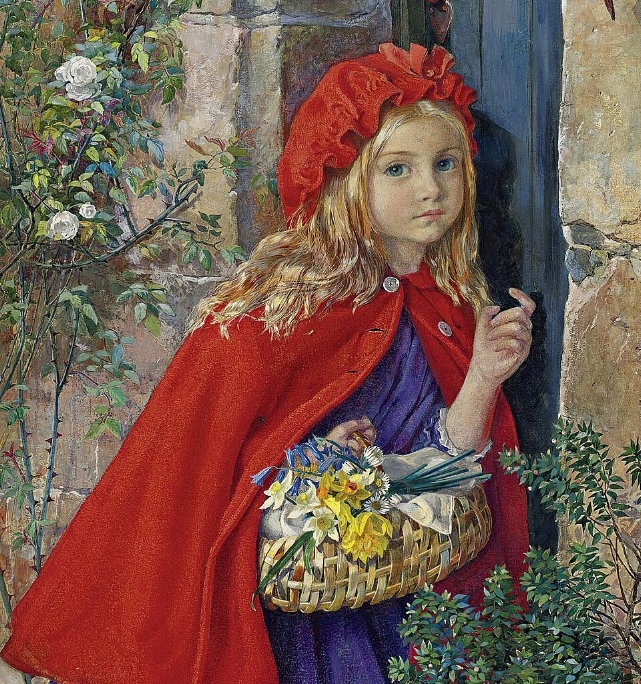
Second illustration – Isabel Naftel, Little Red Riding Hood, 1862