
Hearing That Wants to Become Living Again by Ralf Tita, PhD
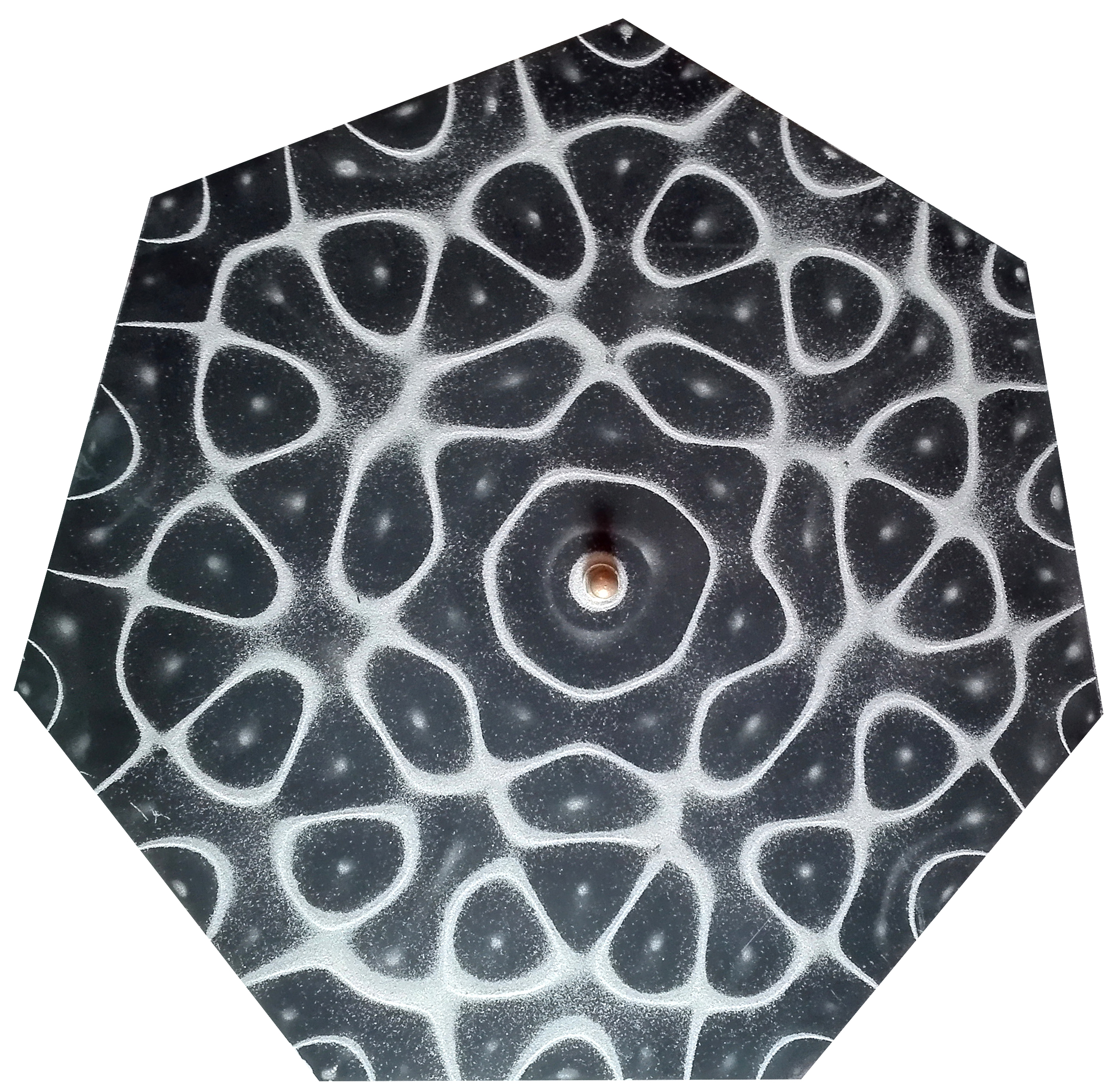
A Chladni figure: Fine particles gathered into form by the shaping power of sound on a sounding plate.
Cymatics, Living Sound, And The Human Being In An Age Of Technical Listening
There are moments when hearing becomes more than reception. Anyone who has sat in a truly living concert knows this. Before judgment begins, before one decides whether the music is beautiful or difficult, familiar or strange, something has already taken place. Through the sounding space itself, something approaches the listener. The sound has already done something. It reaches the human being not merely as information, but as presence. At times it is as though a quickening force were streaming toward us through the music. One does not feel merely touched by sound, but inwardly gathered, quietly addressed, and in some subtle way set upright.
Such moments may help illuminate one of the more hidden questions of our time. We live surrounded by sound as no previous generation has. Music follows us everywhere. Voices arrive through devices. Technical soundscapes fill our homes, cars, clinics, waiting rooms, shops, and places of work. And yet many people feel, often without quite knowing how to say it, that much of what reaches the ear no longer nourishes but tires. Sound is more abundant than ever, yet genuine listening may be becoming rarer.
The Question of Sound
This is not only a technical question. It is a human one. What is sound, when it is no longer understood only as frequency, amplitude, and signal? What is hearing, when it is no longer reduced to sensory intake? And what happens to the human being when sound is mediated almost entirely through technical means?
A way into these questions opens through cymatics. Again and again it leads to a simple yet astonishing fact: Sound does not merely pass through matter; it reveals itself in matter. Sand scattered on a vibrating metal plate does not remain evenly spread. It gathers. It arranges itself into figures — stars, rosettes, lattices, geometries that seem almost to have been drawn by an invisible hand. These are the classic experiments of Ernst Florens Friedrich Chladni, and to the eye they appear almost still, as though sound had paused for a moment to leave a signature in substance.
Yet the stillness is only apparent. The form is born out of ongoing activity. The particles are in constant motion, separating and gathering, and through this movement the figure comes into being. Sound here does not merely strike matter and vanish. It orders. It articulates. It shapes.
A later observation by Michael Faraday reveals a further dimension of the phenomenon. Under certain conditions, the finer and lighter particles are carried not primarily by the plate itself but by currents in the air above it — streaming, swirling, flowing. What first appeared as pattern now reveals itself also as movement. The sounding field is not only figure; it is also flow.
Hans Jenny, the Swiss physician and researcher who gave this field its name, recognized that these aspects cannot in fact be separated. Wherever vibration becomes perceptible, form, movement, and rhythm are present together. Yet rhythm is not simply a third element placed beside the other two. It is the sustaining field that spans and holds the poles of figure and dynamics. Form appears as the structured, visible pole; movement appears as the flowing, kinetic pole; rhythm generates and carries them both. One can emphasize one aspect or another, but none can be removed without the phenomenon itself disappearing. Jenny called this the triadic primal phenomenon.
Schooling in Perception
Cymatics thus becomes a schooling in perception. It asks us to notice that sound is not only heard by the ear, but may also be seen in its ordering power, followed in its streaming life, and recognized in its rhythmic nature.
A short sentence from Jenny’s diary carries the matter directly into the question of the human being:
“Listen! Hearing; awakening to hearing. People cannot hear. This sense is not yet developed.”
This points to another level of listening, one that has not yet fully awakened — a hearing in which the human being is inwardly active, not merely affected.
Rudolf Steiner repeatedly referred to the Chladni phenomenon not as an incidental acoustic curiosity, but as a revealing image of formative activity in nature and cosmos. In one lecture he described how, in earlier conditions of earthly evolution, substances in the watery element were ordered by the harmonies of the spheres, much as sand is ordered on a sounding plate. Elsewhere he makes clear that tone cannot be reduced to a physical event in air, but belongs to a subtler ordering activity working in space and substance.
From within this stream of thought, sound belongs to the formative life of the world. It is not simply a byproduct of matter in motion. It is one of the ways the world articulates itself into form.
A closely related understanding appears in the work of Günther Wachsmuth. In his description of tone, the phenomenon does not arise merely through mechanical vibration, but through the meeting of two etheric tendencies: One working toward expansion and rarefaction, the other toward inward gathering and densification. What we hear as tone is born where these opposing tendencies meet within substance.
Here the image of sound changes profoundly. Tone is no longer adequately described as a wave passing through air. It begins to resemble a breathing process, living between poles. This matters because the human being also lives between poles. If sound itself bears this formative, moving, and rhythmic nature, then it cannot be indifferent how it is brought to the human being.
Technology and the Act of Hearing
This is where the question of technology becomes unavoidable. The issue is not only whether reproduction is accurate or impressive. The deeper issue is whether a technical medium supports or injures the act of hearing itself. Does it leave room for the listener’s inner participation? Does it intensify passivity, fatigue, and subtle coercion? Or can it serve a more living mode of listening?
To follow this line of thought further, one must ask what happens when sound is no longer born directly in living space, but reaches the human being almost entirely through technical mediation.
All living sound bears within it a polarity. A bird’s song, a human voice, a bowed string, the wind moving through trees — each sounds outward, and yet each also draws the listener inward into its field. Sound does not merely strike us; it gathers us into relation with itself.
In German, one may speak here of Klangsog. The word is difficult to translate fully. It points to something in the sounding event itself: That alongside the outward movement of sound there is also an inward, formative, drawing quality.
This matters because conventional electronic reproduction emphasizes only one side of this polarity. A loudspeaker projects sound outward by pressure. Air is set in motion and driven toward the listener. However refined the reproduction may be, the sounding event can lose something essential: Its inward gesture, its formative return. What remains is the projective side of sound without its corresponding draw — the more explosive aspect without the implosive one.
From what has just been described, one may recognize that something etherically significant is weakened in this process. In Wachsmuth’s description of tone, sound is born through a polarity of rarefaction and densification, of outward expansion and inward gathering. If this is so, then the missing element in technical reproduction is not merely a subjective impression of warmth or depth. It is connected with the loss of that implosive principle through which tone becomes more than pressure and begins to work formatively.
Over time, the organism may register this absence, even where the mind does not name it. One does not necessarily experience it as a clear defect, but as fatigue, flatness, or the feeling of being pressed upon rather than inwardly met. The nervous system adapts, but adaptation is not the same as nourishment.
The question then becomes whether technology can serve the listening process more fully — whether reproduced sound can recover something of that missing inward movement. This is the question Atmani took up over many years of cymatic research and artistic practice. His concern was not simply to improve conventional playback, but to ask whether the formative insights of cymatics could lead toward another way of mediating sound.
Lautsänger Technology
If sound reveals itself in form, movement, and rhythm, then the shape and material articulation of the sounding body cannot be incidental. They belong to the life of the tone itself. Out of this work, Atmani developed what may be called the Lautsänger technology: A new approach through which conventional speakers and headphones can be transformed, based on insights from cymatic research and intended to restore something of the inward, implosive quality that ordinary electroacoustic reproduction loses.
This orientation becomes especially meaningful wherever people are no longer able simply to adapt to technical sound. In a therapeutic account, Kaylee Carrington describes years of severe sensitivity to artificial noise following serious illness. Man-made sounds became overwhelming and dysregulating, accompanied by sleep disturbance, pain, migraines, panic reactions, and chronic nervous over-arousal. Against this background, her experience of listening through Lautsänger was strikingly different. The sound was no longer felt as compressed or flattening, but as spatially ordered, differentiated, and in some sense self-supporting. Over time, music ceased to be a threat and became once again a medium of emotional access and regulation.
A physiological indication appears as well. In a double-blind randomized study at University Medicine Heidelberg/Mannheim, one hundred volunteers with elevated stress listened to music through two different headphone systems. Both produced relaxation-related effects. Yet only in the Lautsänger group were additional significant changes observed in the resistance index and in the combined variable termed vascular age. Such findings do not conclude the matter, but they point toward an important possibility: That the way sound is mediated may influence not only subjective impression, but the depth of bodily regulation.
Seen from the standpoint of cymatics, this is coherent. The organism may respond not only to musical content, but also to the inner ordering of the sounding event itself. Where sound bears both its outward and inward movement, both its projective and its gathering character, the human being may be met differently — and the body may begin to regulate differently as well.
Living Sound
This may also help explain why live music so often feels different from technically reproduced sound. In a living performance, sound does not appear as a stored object. It is born in the moment through breath, gesture, bodily presence, resonance, and space. The listener is not simply presented with a result, but met by an unfolding event. Something of the becoming of sound remains perceptible.
Hans Jenny’s diary sentence returns here with particular force: Hearing is not merely given; it may itself have to develop. It can become dulled, overrun, and fragmented. But it can also be refined, awakened, and deepened — and the sounding environment in which a human being lives makes a real difference to which path the faculty of hearing actually takes.
Cymatics, then, may be more than a specialized field of research. It may become a path of education in listening and in perception more generally. It reminds us that sound is not only audible, but formative, rhythmic, dynamic, and revealing — and that hearing belongs to the whole human being. It also asks of technology a question that modern culture rarely dares to ask: Not only what a technology can do, but what kind of human being it helps to cultivate.
If that question is taken seriously, then living sound is not a slogan. It names a cultural task.
Ralf Tita holds a PhD in engineering, computer science and electronics. He is responsible for the product management of Lautsänger, serves on the faculty of the International School of Cymatics, and is a board member of Orphideum e.V. His work focuses on cymatics and its practical applications. ralf.tita@orphideum.org; https://lautsaenger.com; https://www.schule-fuer-kymatik.org