
Three Voices In the Grand Forest by Mary Lou Sanelli
Much like things done and said throughout the world lately, nothing my friends do or say really surprises me anymore. For instance, a friend who lives in Seattle is moving to Costa Rica “to live near toucans,” she said. “Toucans are beautiful and known for their problem-solving abilities, so, you know, way smarter than the folks running this country. Go ahead, quote me, I don’t care.”
We nod at each other because we both know I will.
An eagle circles above as I make my way down the narrow road that leads to the ferry terminal then quickly turns back up the hill, as if it wants the steady influx of tourists to merely glimpse the sea before retreating.
I’m often moved by the sight of an eagle. Its sweeping vision reminds me to see the bigger picture. Like how there are so many reasons to move on. And how for most of us a bird, any bird – even an exotic bird – is something. For others, it’s enough.
And it barely fazed me when a neighbor told me that I’m out of touch. Actually he said, “I can’t believe you don’t know the Seahawks won the Superbowl! It’s the NFL!”
I didn’t know.
I will never know about football. You couldn’t pay me to know about football. I don’t know the NFL from Adam. What I do know is that sometimes I love the idea of neighborly chitchat more than the actual chitchat.
Besides, he didn’t know what PNB (Pacific Northwest Ballet) stands for. So in my world we are even.
But wait. I did hear something lately that did surprise me. And it’s been circling around in my head waiting to be told.
REPLAYING THE SONG
I was enjoying a cup of coffee when the friendly guy across from me shared that he’d just returned from directing the Brooklyn Youth Chorus. Here’s what he said, though I’m sure I’m leaving some important details out: “We hooked the kids up to these head monitors and asked them to think, just think, the lyrics, no actual singing, and then we replayed the song their brainwaves resonated.”
I don’t know why this kind of work should surprise me by now. But it does.
I stir my coffee for a good long minute, asking my insides for the perfect response that doesn’t come. So I say, “That’s amazing!”
It wasn’t how I felt.
It was more like a necessary lie when a nec-essary lie is all you’ve got. I could not for the life of me think of what else to say because what I really wanted to say is what I said next, “I lied. That’s horrible!”
“I know, I know,” he said with a laugh (thank goodness), but he used to rent a small apartment in Pioneer Square. And with his new work in AI, he’s been able to buy a home. So there’s that.
There is always that.
I used to think the world would progress past profit at any cost, but I don’t think that anymore. To be fair, we also talked about all the good things AI is creating. Because it is. We talked about how difficult it is for any of us to understand the full depths of AI, calling to mind a note I’d scribbled down, one of many that make up my toolkit: Upton Sinclair’s wise saying, “It is difficult to get a man to understand something when his salary depends upon his not understanding it.”
I sat there feeling the inevitable future―hu-mans working to replace humans; our careers, creativities, voices – with, I admit, a child’s level of comprehension. I grew more and more edgy as I imagined those kids who love to sing being preempted by artificial sound, so that I walked home along the path that edges Eagle Harbor because I now felt nowhere near sociable enough to walk on Winslow Way.
THE GRAND FOREST
Preempting our voices might be the thing that proves too much for me, so when I reached home, I grabbed my bike and rode out to the Grand Forest. I needed to be surrounded by trees. And well, not to overdo it, forgive me, but the Grand Forest always makes me remember how unbe-lievably lucky I am to choose where I live.
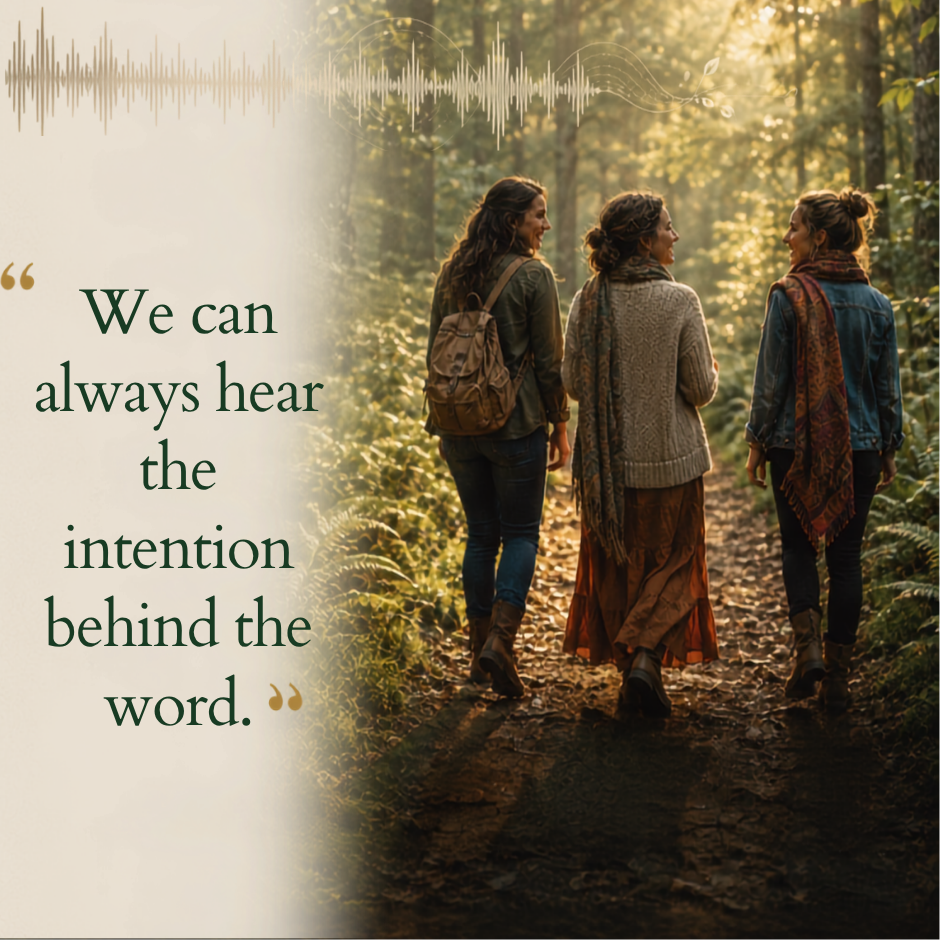
Ahead of me, a welcome sight. Three women walked and talked and even from a distance, I enjoyed their company.
I loved how their chatter spread through the chilly air. One woman said something that made the others laugh. The tone, the inflection, the humor made me feel as though they were bound to discover things by speaking freely, things about themselves and things about each other that they didn’t know before, or didn’t want to know before; may not even want to know now, but that’s just it. I loved it when one woman said, “I can’t believe I just said that.” And another said, “I can.” I loved every minute of their conversation because I loved every minute of it.
With each step I was less concerned. The relief I felt wasn’t gullible denial or naïve hopefulness, it was recognition. In the most human sense. Recognition of sounds that will find their way past all our defenses and aim straight for our . . . I almost said heart. But that’s such a cliché.
Then again one person’s cliché is another person’s eye-opener. And we can always hear the intention behind the word. Heart. So be it.
Our voices took between 100,000 and 200,000 years to develop into language. And they will be around until I die. And that’s the first time a thought like this actually makes me happy.
Mary Lou Sanelli’s latest title is In So Many Words. An Island Called Bainbridge: People, Places, will be published in the fall of 2026. She works as a writer, speaker, and master dance teacher, and lives on Bainbridge Island, Washington. For more information visit www.marylousanelli.com.