Redoing Vocation by Adeline Lyons
Redoing Vocatin
Adeline Lyons
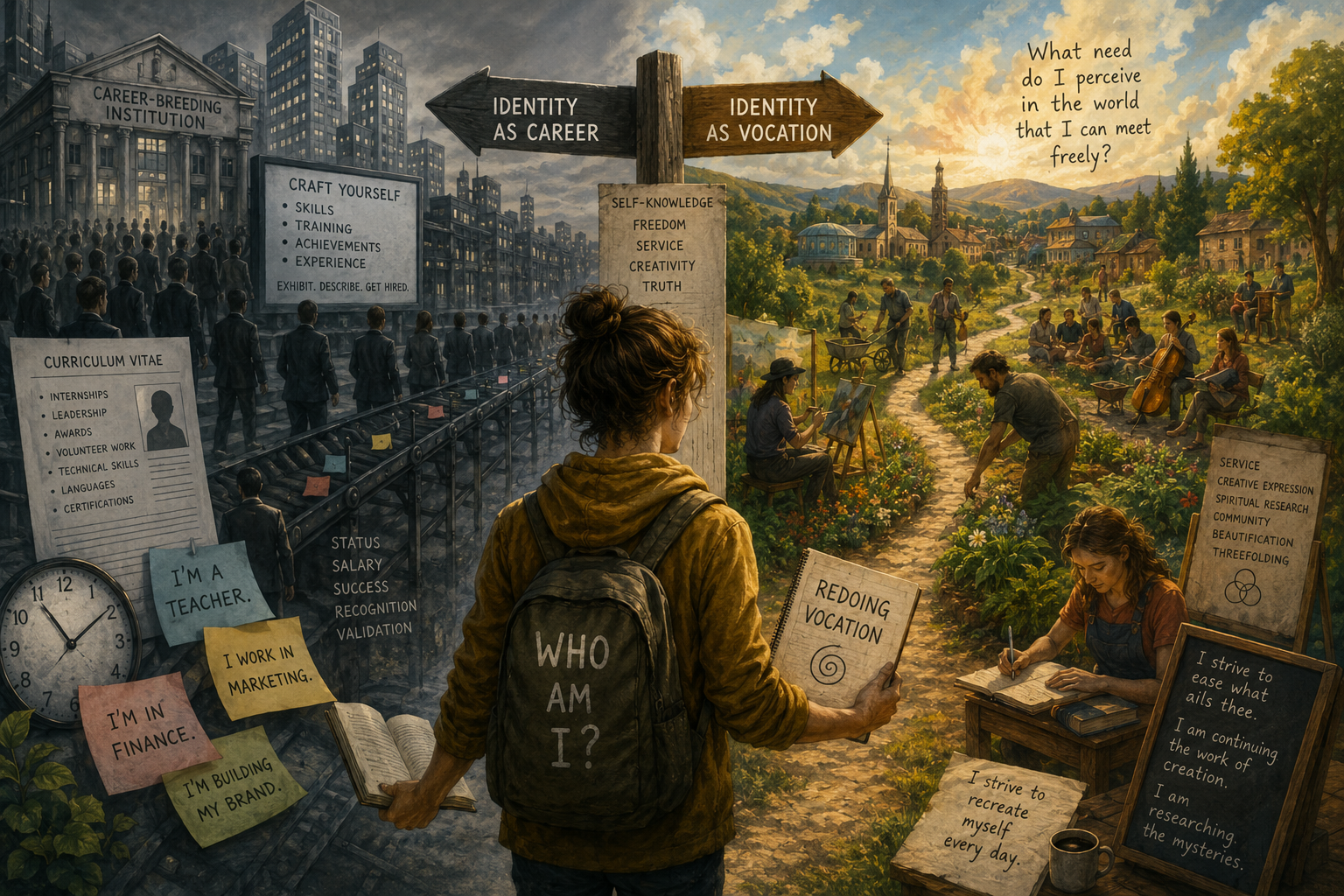
Young adults today are facing crises of identity. They must attend a career-breeding institution, and after crafting a pristine “self”
that can be exhibited or described in a matter of minutes, they can expect to be hired. Thus, career has an unhealthy tyranny over identity. What one says about themselves at social gatherings these days is so typical that it could fit into a formula. Usually, it is a litany of careers or career-building activities, or trainings that aid the achievement of a position. This reflects a fundamental aspect of today’s social paradigm. Identity can be free of a career insofar as it is called “hobby,” “family,” or “personal life.” I am not implying that everyone has become an identity-career person, or that there aren’t people out there reimagining vocation through their deeds. There are plenty of teachers who definitely cannot be summarized by the word “educator.” They are actually just multi-faceted individuals engaged with the diversity of life itself, who happen to work in a school context because it makes sense for such people to be around children. But by and large, especially in the world beyond spiritual communities, career is the “end” that the means of one’s actions lead to.
While what we do can be who we are, it is not ideal that activity precedes self-knowledge to any great extent; meaning, the bullet points on one’s resume should not inform me about myself. Rather, self-knowledge should be the impulse of volition from which those activities arose. But I’ve observed, during my time spent in universities, that the trends one follows, along with personal tastes, political opinions, and quirky skills, all of which can subtly find their way onto a cover letter, have become significant parts of character and, consequently, career potential. Our actions are collected into curriculum vitae and resumes that display the activities that constitute our lives, and identity forms a “landing site” for a career. Once we land there, who are we?
We arrive at careers through systemic traditions—family circumstances, economic status, education, and, to some extent, personal interests, none of which are free. Even interests are often confined within the frameworks of career, making us unaware of what life could be like if vocation consisted simply of freely enacted deeds, where my interests cannot be categorized because they are actually the result of my own individual being. Freely enacted deeds are what I can do if I abandon frameworks altogether, leaving behind notions of success, ambition, or temptations of promotion, and give my attention instead to the riddle of myself in time. Meaning, to the nature of “me” in temporality in relation to the “I” who guides me in eternity. How I journey through the minutes, hours, and months of linear life is indeed a riddle to solve by attending to the reality of my higher self. What does myself in time actually want to do in my time? Beyond the wants that are fallen—want of money, recognition, validation, etc.—what does my highest self aim for? What need do I perceive in the world that I can meet freely, not out of force or obligation? When I listen to this, “I” can guide “me” through time, as a shepherd guides its flock.
What if cities, communities, and villages were built around the idea of vocation as a result of freely given service, creative expression, or spiritual research? Such a shift would radically transform social, economic, and cultural life, by lifting it out of the “I get paid six figures a year to diagnose people’s illnesses” or “I blew up on TikTok and now get paid a lot” paradigm and into a world-village whose workers might say: “I strive to ease what ails thee through the activity of my life,” or “I am continuing the work of creation,” or “I am researching the mysteries.”
I want to form a new covenant between true self and deeds, or what today we would call identity and career. Not the collusion of self and exploits, where the question “what do you do?” ends in “I’m a teacher.” Rather, a world in which one’s vocation is an outward manifestation of one’s truest, inner self. Thus, where my deeds are relevant to reality—the place and time in which I live, the name I have, the people I know.
The epoch we live in demands that our actions align with our truest selves and highest aspirations. What does it mean to take ownership of your deeds truly? Beyond clichés of accountability and responsibility, how can we awaken to the impact of our deeply individual tasks? Ideally, each action I complete is a whole in itself, not bullet points of feats that encapsulate my identity. Every task I complete in the present is informed by my presence in both past and future, and has the potential to transform reality. I can cultivate the present reality through cognitive willpower, and thus the deeds of my life form my biography. I must see myself as the destination of everything life brings me. I must meet life with a sense of responsibility for the experiences I have, knowing that they are not encounters I am subject to, or operative within, but rather significant events pursued by my higher self in the context of eternity. My freely chosen deeds create my destiny.
So what do I mean by the title of this essay—”Redoing Vocation”? Partly, it involves changing our relationship with language, which has become more and more categorical. What does “writer” truly mean? Or “teacher”? Or “farmer”? How might we combine these labels into a new one—perhaps “writer-teacher-farmer”? This isn’t about creating multi-talented hobbyists leading a jack-of-all-trades lifestyle, but rather about asking—how do these roles fulfill real needs? What do those needs look like, both external and within? Of course, it also requires a shift in our relationship to money, which is deeply bound to notions of time and labor, but entirely abstracted from the relevance of one’s efforts.
Where does free will, the Michaelic impulse, align with the world’s needs, or with cosmic needs? While sacrifice is involved, in the sense that we cannot only do what we feel “called to do” all the time but must compromise so that our I-sense meets world-sense, this intersection doesn’t have to mean commodification or the efficiency obsession we see today. Why must every teacher follow the same training and meet identical standards? What are writers really doing? What if a group of people adopted a “vocation” focused purely on bringing social threefolding to an entire country? They wouldn’t be working to get paid—utilizing their creative vision on the clock—but would instead engage in the study and practical application of social threefolding, where cultural, economic, and rights spheres work harmoniously. Could twenty individuals’ vocations be “social threefolding” without it needing to become a company or organization? Could a bread baker deliver bread within a certain radius without streamlining it through stores? Could a group of gardeners take on the beautification of an entire town? Could police be there as service-workers? As a young person, I don’t want to answer, “What do you do?” with one or two labels. I’d rather say, “I strive to recreate myself every day.” Of course, this may sound poetic or superficial in today’s culture. But perhaps a little more vision is needed if we are to preserve the future of vocation.
Reprinted from the Fall 2025 issue of Futuring Now, a publication of the North American Youth Section https://simplebooklet.com/futuringnowyspublication#page=1
Adeline Lyons currently resides in the new Threefold Youth House in Spring Valley, New York. She is engaged in various projects, mostly
involving a combination of writing, acting, event visioning, editing, and anthroposophy. She is committed to transformation.